Castlings
The Old AxolotlThe Castlings are humano inhabitants of First Paradise whose lives embody a central tension in its history: the attempt to create a new way of existing has been overtaken by inherited human fantasies and successive transformations. They appear not only as a people formed by that process but as individuals in scenes of play, caregiving, loss, and startling reconstruction. Their presence makes First Paradise feel at once like a community and like a world whose members can no longer be securely distinguished from the stories, technologies, and memories that shaped them.
Identity and Formation
The Castlings belong to the humano generations that emerge within First Paradise. Dagenskyoll describes the community’s beginnings as an effort to escape the imposed performance of human work: transformers might instead have lived a distinctively transformer life if the memory of thousands of years of hunter-gatherer culture had been preserved. That alternative did not prevail. The founders called their creation Paradise, but the word itself summoned idealized images of the pre-Extermination world from the archives. The first humanos absorbed those images, and later generations continued to transform, enter alliances, and give birth to more humanos through an epigenesis increasingly influenced by Hollywood.
Dagenskyoll presents the result as a long historical drift, not a single founding mistake. After thirty kilodays, he says, Paradise has become a children’s park assembled from Disney, Pixar, cartoons, and comics, growing more infantile with each generation and more disconnected from the truth about humanity. His qualification that this may simply be his own view leaves the diagnosis open to doubt, but not the underlying conflict: the Castlings’ cultural inheritance is made from memories that are already mediated and idealized. Their world’s apparent innocence is therefore neither untouched nature nor a clean break with humanity. It is a new form of life carrying human fantasies forward.
Community, Play, and Care
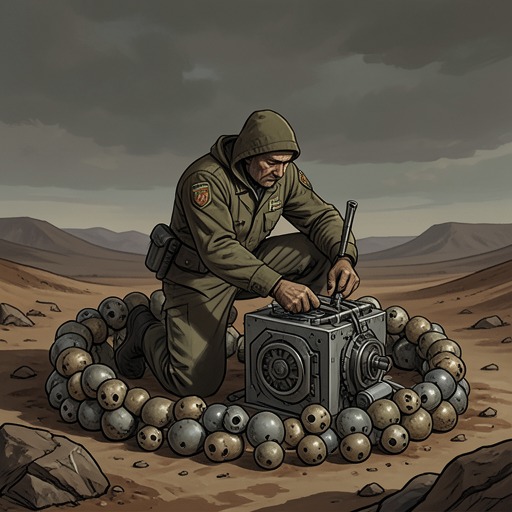
The Castlings appear together in a scene of exuberant spectatorship as Bartek and Dagenskyoll fight their way toward the foot of a tower. They run around the combatants, clapping and singing about the transformers fighting and bashing. The crowd turns the encounter into public play: the robots’ violence becomes an event the Castlings can celebrate together. Their refrain is simple, but its setting is not. The combatants are battered machines, their blows resounding across a sandy wasteland; around them, the Castlings create the atmosphere of a communal spectacle.
A more intimate image places a humano Castling asleep on Lady Spiro’s lap beside a fire. Curled into a half-embryonic posture, the sleeper is held and gently stroked while Lady Spiro bends over it with a tenderness the narration associates with a mother. The scene frames the Castling as vulnerable and dependent, but does not explain the exact nature of Lady Spiro’s bond with the child. Rather than reduce that relationship to a stated biological role, the image emphasizes care enacted through touch and shelter. The sleeping figure’s stillness also contrasts with the running, singing crowd: Castling life is shown both as collective commotion and as quiet bodily trust.
Loss and Reconstruction
Bartek’s grief gives the Castlings’ transformations a personal cost. He names Mika, Floki, Sloki, Dedek, and Philomenka as individuals who let themselves be vectored without saying goodbye. He fears that they regarded him not as a companion but as furniture or obsolete equipment: a cupboard of vacuum tubes, an old computer, or a blow-up doll. His comparison reduces a relationship to usefulness and possession, expressing the humiliation of feeling left behind by beings who may no longer recognize him as someone to whom a farewell is owed.
When he is told that they have not gone anywhere and can still be seen or felt, the disagreement is not resolved. The reassurance asserts continued presence, while Bartek’s complaint insists on the loss of reciprocal recognition. The exchange leaves open what their being vectored means for those who remain and for the identities of those who have changed. In this context, a newly made humano-unbirther approaches Bartek with an especially unsettling resemblance: it hops in a Dedek-like manner and displays an affectionate emote. The scene links an act of creation to the memory of a particular absent individual, without establishing that the new being is Dedek.
Narrative Significance
The Castlings’ appearances hold together the competing meanings of First Paradise. They are children of a culture that has inherited idealized human media, yet the story also presents them as embodied beings who sleep, gather, sing, form attachments, and become objects of grief. That concrete vulnerability complicates Dagenskyoll’s broad criticism of an increasingly infantile society: the Castlings are not merely evidence in an argument about cultural decline but participants in relationships that matter to others.
Their world also makes the boundary between birth and manufacture unstable. Lady Spiro retrieves the scorched arm of the Schmitt 4 from the embers and strips the scrap metal into its component parts. She combines it with twigs, grass, charred logs, and bones from a roasted rodent, then takes a clock spring from beneath her own ribs and fits it into the rag-doll body. With sand, water, and a kiss, she brings a humano-unbirther to life. Its movements echo Dedek’s, and it approaches Bartek with an affectionate emote. This is neither an ordinary birth nor a simple repair: the new Castling is assembled from machine remains, gathered organic matter, and Lady Spiro’s own body.
The scene makes creation inseparable from loss. The old arm is first treated as a relic of a brother mech and thrown into the fire by Bartek; it is then recovered and transformed into a being that seems to recall someone he misses. The Castlings therefore inhabit a paradise where inherited stories and changing forms continually remake life, but where resemblance cannot guarantee return. Their significance lies in that unresolved doubleness: they are the community First Paradise has made, and living evidence of how little control its inhabitants have over what their creations, memories, and departures will mean.